

The signs you need an attic inspection in Virginia are easy to dismiss one by one. A room that runs warm in summer. An energy bill that keeps edging up. A draft you cannot pinpoint. Each symptom on its own sounds like a minor inconvenience, but together they point at the same place: the attic above your head. And the longer you wait, the more every heating and cooling season costs you.
Virginia's climate pushes homes hard in both directions. Northern Virginia summers bring sustained heat and humidity that stress under-insulated ceilings from June through September. Winters in central and western parts of the state pull heat straight up through whatever insulation the attic happens to have. Most homes built before 2000 were constructed under standards that fall well short of what Virginia's updated building code now requires, and that gap shows up in comfort problems and energy waste every single day.
An attic inspection puts a concrete number on the gap and tells you exactly what is causing the symptoms you have been attributing to the weather or the equipment. Understanding what those symptoms mean, and recognizing them before another season runs past, is how Virginia homeowners stop throwing money at a problem that has a straightforward fix. A look at signs you have poor home insulation often confirms that the attic is where the problem starts.
In this article, you will learn about:
- The most common signs that your Virginia attic needs an inspection now
- How Virginia's climate and building code raise the stakes
- What an inspection actually looks for in typical Northern Virginia homes
- The problems that compound every season you skip the inspection
- How to act on findings before the next seasonal shift hits your bills
Keep reading to understand exactly which warning signs mean it is time to stop waiting and get a professional set of eyes on your attic.
The most common signs that your Virginia attic needs an inspection now
Most of these signs have been present for more than one season before homeowners connect them to the attic. They get attributed to the HVAC system, to an old house, or to a particularly rough year weather-wise. What they are actually measuring is thermal and air performance, and the attic is almost always the primary driver.
Upper floors that refuse to cool down
The clearest sign of attic insulation failure is a room your HVAC system simply cannot control. Upper floors that run 5 to 10 degrees warmer than the main level in summer, or noticeably colder in winter, are communicating that heat is moving freely through the ceiling above them. The system is not broken. It is fighting a thermal boundary that is not doing its job.
This pattern is especially common in Northern Virginia homes with finished second floors directly under the roof line. The heat load coming through the ceiling in July overwhelms whatever the AC is trying to accomplish, and the result is a room that stays uncomfortable regardless of the thermostat setting. Knowing how effective attic insulation actually is at addressing this specific symptom clarifies why the inspection, not an equipment upgrade, is the right first move.
Energy bills creeping up without explanation
Virginia homeowners who watch their utility bills closely often notice a gradual increase that cannot be explained by rate changes alone. Heating and cooling account for roughly half of a home's total energy use, according to the U.S. Department of Energy, and the attic is the primary path through which conditioned air escapes. A home that is losing more than it should will run its HVAC harder and longer to compensate, and that extra runtime appears directly on the bill.
The pattern to watch for is not a sudden spike but a slow drift upward year over year. Insulation settles and compresses over time, and how long attic insulation lasts has a real answer: most blown-in products begin losing meaningful performance after 15 to 20 years, and fiberglass batts compress even faster when disturbed.
Watch for these specific billing warning signs before booking an inspection:
- Summer bills climbing year over year despite consistent thermostat habits
- Noticeably higher winter heating costs compared to similar homes on your street
- AC running near-continuously on 90-degree days without reaching setpoint
- Utility bills that spiked after a contractor worked in the attic and may have disturbed the insulation
Drafts moving through the house when nothing is open
Drafts in a well-sealed house point to air moving through the building envelope, not just around windows and doors. The stack effect drives this: warm air rises through the house and exits through the attic, pulling cooler outdoor air in through lower-level gaps to replace it. In a Virginia home with significant air leakage at the ceiling plane, this creates noticeable drafts at the base of walls, around recessed lights, and near the attic hatch even when every exterior opening is closed.
Attic air sealing addresses the top of this air pathway directly. When the ceiling plane is sealed at top plates, around penetrations, and at fixture openings, the stack effect is interrupted and the drafts at lower levels stop. An inspection identifies exactly where the leakage is occurring so that work targets the right points rather than chasing symptoms throughout the house.
The attic hatch is cold or warm to the touch
Put your hand on the attic hatch cover or pull-down stair panel. If it is noticeably cold in January or warm in July, that surface is transferring temperature directly into your living space. Attic hatches and pull-down stair frames are among the most common air leakage points in Virginia homes, and most of them have no insulation on the back and no weatherstripping on the frame.
This is a small but telling symptom. A warm hatch in summer is a near-certain indicator that the rest of the attic floor has similar gaps. An inspection maps all of these points together and confirms whether what you are feeling at the hatch is isolated or part of a larger pattern. Connecting this symptom to attic insulation replacement decisions becomes straightforward once the full picture is on paper.
You have never had the attic professionally assessed
This sign is simple and frequently overlooked. Many Virginia homeowners have lived in their homes for a decade without ever having a professional evaluate the attic space. A home inspection at purchase checks for structural and safety conditions; it does not measure R-value depth across the full attic floor or locate air leakage pathways.
The most common things inspectors find in Virginia homes that have never been assessed include:
- Insulation depth far below the current R-60 Virginia code target, often as low as R-11 or R-19
- Top plates left completely open along every interior wall
- Recessed light cans with no attic contact rating and no air sealing
- Bathroom exhaust fans venting into the attic rather than outside
- Baffles missing at the eaves, allowing blown-in material to block soffit ventilation
If you own your home and do not know your current R-value or when the insulation was last touched, the inspection is already overdue.
How Virginia's climate and building code raise the stakes
Virginia is not a uniform climate, and that matters when evaluating attic performance. Northern Virginia sits in Climate Zone 5, where winters are cold enough to drive serious heat loss through under-insulated ceilings. Central Virginia is Climate Zone 4, a mixed-humid zone with hot summers and genuine winters. Southern Virginia reaches into Zone 3, where summer cooling loads dominate. Each zone has different code requirements, and most older homes across all three fall short of them.
Virginia's updated R-60 requirement
Virginia adopted the 2021 Uniform Statewide Building Code in January 2024, raising the attic insulation requirement for most of the state to R-60 for vented attics, up from the previous R-49. That change reflects the state's recognition that R-49 was underperforming in real-world conditions across Virginia's mixed and cold climates. The requirement applies to new construction and major renovations; existing homes are not legally required to upgrade unless they undergo qualifying work.
That legal exception does not change the thermal reality. A home sitting at R-19 or R-25, which is common in Virginia housing built between 1970 and 1995, is losing heat and gaining heat at a rate that costs real money every season. According to ENERGY STAR, homes with insufficient attic insulation and air leaks can run utility bills 10 percent or more above a comparable well-insulated home. The role of insulation in creating an energy-efficient home goes well beyond code compliance; it is the highest-leverage upgrade most Virginia homeowners can make.
Northern Virginia's dual-season pressure
Northern Virginia homeowners deal with summer heat gain and winter heat loss at levels more demanding than the mid-Atlantic average. DC metro summers push attic air temperatures past 150 degrees Fahrenheit, while winters bring sustained cold that drives aggressive heat loss through ceilings that do not reach the R-60 standard.
This is why thermal insulation contractors in Virginia consistently identify the attic as the first place to address in Northern Virginia homes, ahead of walls and windows. The ceiling is the largest single surface separating conditioned from unconditioned space, and it operates under the highest thermal stress across both seasons.
Older Virginia homes and retrofit complexity
A significant portion of Virginia's housing stock dates from before 1980, and these homes present attic conditions that differ from newer construction in ways that matter for planning an upgrade. The best insulation approach for older homes differs from new construction recommendations in meaningful ways. Common findings during inspections of pre-1980 Virginia homes include:
- Knob-and-tube wiring that cannot be covered with insulation without an electrician's clearance
- Original ventilation systems that are structurally inadequate for today's insulation depths
- Insulation that has been compressed, shifted, or contaminated by years of foot traffic and prior contractor work
- Deteriorated batts or blown-in material that must be removed rather than topped off
Understanding insulation removal services as a potential first step, rather than an unexpected complication, is part of what a professional inspection makes clear before the upgrade work begins.
What an inspection looks for in typical Virginia homes
An attic inspection is a systematic evaluation of four interconnected systems: insulation depth and coverage, air sealing integrity, ventilation performance, and moisture conditions. Understanding what the inspector is checking helps you recognize which symptoms in your home connect to which specific problems.
Insulation depth and coverage across the full floor
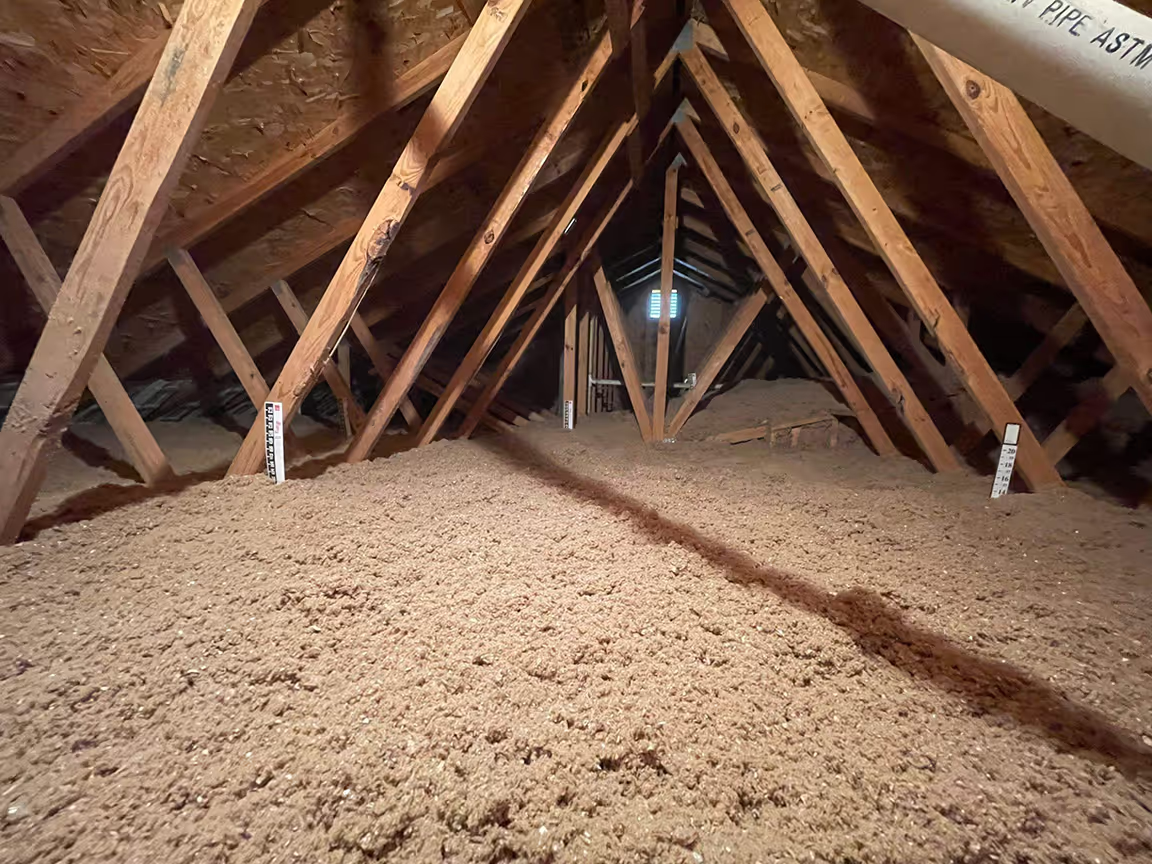
The first thing an inspector measures is insulation depth at multiple points across the attic floor, including the areas near the eaves that are hardest to reach and most commonly thin or missing. Most homeowners who have been in their attic have looked at the insulation near the hatch but have not evaluated coverage at the perimeter.
Thin spots near the eaves are extremely common in Virginia homes. Blown-in insulation migrates away from the perimeter over time, and batts near the exterior walls often compress or fall away from the top plate. The University of Maryland Extension, covering insulation practices directly applicable to Virginia's overlapping climate zones, confirms that without adequate coverage heat radiates downward through the ceiling in summer and escapes upward in winter, forcing the HVAC to work significantly harder.
Air leakage pathways at the ceiling plane
Air sealing failures are the most commonly missed problem in Virginia attics. They are invisible without a systematic inspection, and they undercut whatever insulation is present by allowing conditioned air to bypass the material entirely. The U.S. Department of Energy notes that reducing home air leakage can trim energy use by 10 to 20 percent annually.
The most common leakage points inspectors find and that attic sealing and insulation best practices address in sequence are:
- Open top plates running the length of every interior wall
- Recessed can lights without attic contact ratings, creating large unsealed holes in the ceiling
- Plumbing and electrical chases open from basement to attic
- Attic hatch frames with no weatherstripping and no insulation on the back panel
- Dropped soffit cavities above kitchen cabinets that connect directly to the attic
Ventilation: intake, exhaust, and baffles
Proper attic ventilation requires a functional balance of intake at the soffits and exhaust at the ridge or gable. When that balance is disrupted by blocked soffits, missing baffles, or insufficient ridge venting, heat builds in the attic and both accelerates shingle deterioration and increases the cooling load on the living space below.
A solar powered attic fan can supplement passive ventilation in attics where ridge and soffit venting alone are not moving enough air. But no mechanical solution compensates for a fundamentally broken ventilation design, and the inspection establishes whether the passive system is working before any supplemental measure is considered. Homes with poor attic ventilation combined with thin insulation typically show both problems compounding each other, and the correction requires addressing them together.
Moisture conditions and early structural damage
Virginia's humid summers create real moisture risk in attics with air sealing failures. When humid conditioned air migrates through ceiling penetrations and contacts the cooler roof deck, it deposits moisture. Over a full season that accumulation builds, and the results follow a predictable escalation:
- First signs: minor discoloration on roof sheathing and top plates
- Progressing: soft spots developing in the sheathing, insulation beginning to mat and lose density
- Advanced: insulation mold growth establishing throughout the material and structural wood showing active deterioration
Finding attic condensation problems at stage one costs a fraction of what remediation costs at stage three. An inspection is the mechanism for catching it early. Where moisture has already compromised existing insulation, understanding the real cost of insulation removal before replacement is part of planning the project budget honestly.
The problems that compound every season you skip the inspection
Every heating and cooling season that passes without addressing an underperforming attic adds measurable cost. These are not problems that stabilize; each of the common issues found in Virginia attics tends to worsen over time, and the longer the delay, the more expensive the eventual correction.
Insulation degradation is not reversible
Insulation that has been compressed, moisture-damaged, or contaminated does not recover its R-value. A batt that has been walked on repeatedly is permanently compressed. Blown-in cellulose that has gotten wet and dried has lost density. The signs that it is time to replace attic insulation include matting, discoloration, inconsistent depth, and any evidence of prior moisture exposure.
Topping off over damaged material means investing in an upgrade that cannot perform to its rated R-value because the base layer is compromised. An inspection catches this before the work begins, which protects the investment in new material.
Air leakage accumulates over time
Air leakage pathways through the ceiling plane do not close on their own. Additional penetrations are created every time a contractor runs new wiring or plumbing without sealing behind them, and the aggregate leakage grows year after year. A ceiling that started with moderate leakage in 2005 has more bypass pathways today, and sealing them before the next heating season has an immediate measurable impact on energy bills year-round.
The ways to reduce AC usage that actually move the needle all share a common starting point: a sealed and properly insulated attic.
Moisture damage escalates if ignored
Early-stage moisture caught at the discoloration phase is manageable. Mold-resistant insulation can go in as part of the upgrade, and the correction is contained. Late-stage moisture damage, where sheathing has begun to deteriorate and mold has established throughout the insulation layer, turns an insulation project into a structural repair.
Virginia homes running heavy AC in summer create significant moisture pressure on the attic because the living space is being actively dehumidified while the attic above may have inadequate vapor management. Moisture control insulation installed correctly as part of an upgrade project addresses the risk before it becomes a remediation problem, and attic humidity problems that are caught by an inspection rarely require the level of intervention that ignored problems eventually demand.
How to act on inspection findings before the next seasonal shift
An inspection without follow-through delivers partial value. The real return comes from translating findings into a prioritized work scope, timed to get ahead of the next heating or cooling season rather than responding to it after the fact.
The sequence that produces the best results
A professional inspection report identifies current R-value readings, air leakage locations, ventilation status, and any moisture findings. The recommended sequence of improvements from that report matters as much as the list of items itself.
The correct order for most Virginia attic upgrade projects is:
- Fix ventilation issues first: redirect exhaust fans outside, install missing baffles at the eaves
- Complete air sealing: seal top plates, recessed lights, plumbing and electrical penetrations, and the attic hatch frame
- Add or replace insulation: blow in to the R-60 target on top of the sealed and ventilated floor
- Address adjacent areas: rim joist insulation in Virginia homes is a common companion upgrade, as is crawl space insulation where the building envelope has multiple weak points
A thermal barrier installed in this order performs to its rated value from day one. Skipping air sealing and jumping to insulation produces an upgrade that still has conditioned air bypassing the new material through every unsealed penetration.
Choosing the right materials for Virginia conditions
Blown-in cellulose and blown-in fiberglass are both appropriate for most Virginia attic floors, and the comparison of spray foam versus fiberglass and blown-in versus spray foam attic options covers the trade-offs in detail for DMV-area homeowners. Spray foam is the right tool for closing the air leakage points at the ceiling plane before blown-in material goes on top. The two materials work together as a system in most complete attic upgrade projects.
For homeowners with health or environmental priorities, non-toxic attic insulation options are available and perform comparably to conventional products at current R-value targets. The cost-effective insulation options in Virginia overview helps homeowners evaluate total project economics before committing to a material choice, and residential insulation services that specialize in the Virginia market can match material selection to both the home's specific conditions and the homeowner's budget.
Rebates and incentives available to Virginia homeowners
Virginia homeowners have access to utility rebates and federal incentives for qualifying insulation and air sealing work. The attic insulation tax rebate programs available through Dominion Energy and other Virginia utilities reward homeowners who complete home performance upgrades, and the federal Inflation Reduction Act extended tax credit eligibility for insulation and air sealing work through 2032.
Starting with a home energy audit is the correct first step for maximizing rebate eligibility. The audit establishes your baseline, confirms which improvements qualify, and generates the documentation utilities and tax programs require. The long-term picture through energy bill savings from insulating makes the economics straightforward: most Virginia homeowners at current energy rates recover the cost of a complete attic upgrade within a few years, and the comfort improvement starts the day the work is done.
Conclusion
The signs that your Virginia attic needs an inspection are present in most homes built before 2000, and most homeowners have been living with them long enough that they no longer register as problems worth investigating. A room that will not cool down, a bill that keeps climbing, a draft with no obvious source: these are not quirks of an older house. They are measurable performance failures that an inspection can quantify and a well-sequenced upgrade can fix.
Getting the inspection done before the next heating or cooling season puts you in control of the timing rather than responding to the worst moment of the year when the problem finally becomes impossible to ignore. The findings tell you exactly what needs to happen, in what order, and what it will cost, which makes every subsequent decision easier and better informed.
When you are ready to find out what is happening in your attic before another Virginia season takes its toll, Terra Insulation is ready to help.