
The rim joist insulation benefits in Maryland are felt immediately and in two directions at once: first-floor temperatures stabilize, and the heating and cooling system stops working overtime to compensate for a gap that most homeowners never knew existed. The rim joist sits at the base of your home's first floor, where the wood framing meets the top of the foundation wall. It runs the entire perimeter of the house, and in most Maryland homes it has little to no insulation at all.
That strip of exposed framing is one of the highest-return upgrades in home performance work. It is thin, it runs along the outside of the building, and it is riddled with the small gaps and cracks that accumulate wherever concrete meets wood.
According to the U.S. Department of Energy, air leaks at the rim joist and sill plate can account for up to 25 percent of a home's total air infiltration. That is a significant share of energy loss concentrated in an area most homeowners have never inspected.
Maryland's climate makes this particular problem worth solving. The state's hot, humid summers and genuinely cold winters put the rim joist under thermal stress from both sides across a full calendar year. Sealing and insulating it in a single project addresses heat gain in summer, heat loss in winter, moisture risk year-round, and the cold-floor complaints that Maryland homeowners have been living with since they moved in.
Understanding home insulation solutions as a whole-house system always points back to this zone as one of the first places to address.
In this article, you will learn about:
- What the rim joist is and why it causes such disproportionate energy loss
- The specific benefits Maryland homeowners see after rim joist insulation
- Why Maryland's climate makes this upgrade particularly valuable
- The materials used and why spray foam is the preferred approach
- How rim joist work fits into a broader home performance upgrade
Keep reading to understand why this often-overlooked strip of framing has such an outsized impact on your comfort and your bills.
What the rim joist is and why it causes disproportionate energy loss
Most homeowners have never thought about the rim joist by name, but they have felt its effects every winter when the first-floor floors are cold, the baseboards along exterior walls run chilly, and the furnace cycles more than it should. The rim joist is the structural member that caps the ends of the floor joists at the perimeter of the home. It sits on top of the sill plate, which rests on the foundation wall, and its outward face is separated from outdoor temperatures only by sheathing and siding.
In most Maryland homes, especially those built before 1990, this area was left without meaningful insulation or air sealing. It was not an oversight so much as a reflection of the standards of the time.
Where the rim joist sits and what makes it so leaky
The junction between foundation concrete and sill plate wood is inherently imperfect. Concrete is rarely perfectly flat, wood shrinks and swells seasonally, and the connection between the two accumulates gaps over decades of thermal cycling. Add in penetrations for plumbing, electrical conduit, and mechanical connections, and the rim joist perimeter of a typical Maryland home has dozens of air leakage pathways that do not require a blower door test to feel on a cold January day.
According to Building Science Corporation, the rim joist is a particularly problematic detail in the building envelope precisely because several structural components converge here: the sill plate, the rim joist itself, and the subfloor above all need to be connected as an air barrier, and getting that connection right is workmanship-sensitive in ways that original construction rarely achieved. The result is a continuous band of air leakage running the full perimeter of the building, driving cold air into the base of exterior walls and conditioning the basement and first floor in the wrong direction.
Why the stack effect makes rim joist leaks worse
Air leakage at the rim joist does not operate in isolation. It interacts with the stack effect driving air movement through the entire building. As heated air rises through the home and exits through gaps at the ceiling and attic level, it creates negative pressure at the lower levels that actively pulls cold outdoor air in through the rim joist.
This means an unsealed rim joist is not just passively losing heat; it is being used as the primary intake point for cold air replacement. The attic air sealing work that addresses the top of this stack-effect pathway is most effective when the bottom is also sealed. Addressing the rim joist and the attic together closes the loop and dramatically reduces the pressure-driven air exchange that accounts for a large share of heating and cooling losses in older Maryland homes.
The thermal bridge problem at the rim joist
Beyond air leakage, the rim joist itself is a thermal bridge. It is a solid piece of lumber running continuously around the building perimeter, connecting the cold exterior environment to the interior space with minimal resistance. Thermal bridging at the rim joist creates cold surfaces along the base of exterior walls and contributes to the first-floor floor temperature problems that are often mistakenly attributed to the HVAC system or to drafty windows.
The University of Maryland Extension notes that properly installed insulation slows heat flow by maintaining comfortable indoor temperatures year-round, and the rim joist is one of the zones where that heat flow is most concentrated. The combination of thermal bridging and air leakage in a single narrow strip of framing is what gives the rim joist its outsized impact relative to its small surface area.
The specific benefits Maryland homeowners see after rim joist insulation
The improvements from a properly sealed and insulated rim joist show up across several dimensions simultaneously. Maryland homeowners who have the work done typically notice the first-floor temperature change within the first heating season, but the benefits extend well beyond warmth.
Warmer first-floor floors and more stable room temperatures
The most immediate and noticeable benefit is warmer floors. Cold outdoor air that was previously entering through the rim joist and rising through the subfloor is cut off. First-floor surface temperatures increase, and the cold-air chill along the base of exterior walls disappears.
In a typical Maryland home, first-floor rooms adjacent to exterior walls often run noticeably cooler than interior spaces during winter. That temperature differential is a direct product of rim joist air infiltration. Sealing it brings those rooms into line with the rest of the house, which translates to fewer complaints about cold spots, less reliance on supplemental space heating, and a living environment that the HVAC system can actually manage efficiently. Understanding how this connects to the broader picture of poor home insulation helps Maryland homeowners prioritize where to start when tackling multiple insulation gaps at once.
Lower heating and cooling bills year-round
The energy savings from rim joist insulation compound across both seasons. In winter, the heating system no longer needs to compensate for the continuous cold-air infiltration at the building's base. In summer, the same sealed perimeter prevents hot, humid outdoor air from entering through the rim joist and driving up the cooling load.
Research consistently shows that insulating your home reduces energy bills meaningfully when the work targets the right zones. The rim joist qualifies on both measures: it is a high-leakage zone and a thermal bridge, so sealing and insulating it in one operation addresses two distinct loss mechanisms at the same time. The attic insulation energy bills relationship gets most of the attention in home performance conversations, but the rim joist delivers comparable returns in a much smaller and faster project.
The energy bill improvements Maryland homeowners commonly report after rim joist insulation include:
- Reduced furnace runtime during cold stretches when the building perimeter is no longer pulling in replacement air
- Lower cooling costs in summer as the sealed rim joist stops humid outdoor air from infiltrating the base of the conditioned space
- More consistent thermostat performance because the HVAC system is no longer chasing infiltration it cannot overcome
- Reduced use of supplemental space heaters in basement and first-floor rooms that were previously too drafty to heat efficiently
Protection against moisture damage and wood rot
Maryland's humid climate creates a specific moisture risk at the rim joist that is distinct from the thermal performance issue. When warm, humid indoor air leaks into the rim joist cavity and contacts the cold wood surface in winter, it condenses. That condensation deposits moisture directly on the structural framing, and without air sealing to stop the process, it repeats every cold night across an entire heating season.
The consequences follow a predictable trajectory:
- Early stage: minor discoloration and surface moisture on the rim board and sill plate
- Progressing: wood darkens, minor surface mold appears, insulation batts begin to absorb moisture and compress
- Advanced: rot develops in the rim joist and sill plate, structural integrity of the foundation-to-framing connection deteriorates
This is exactly the type of moisture problem that moisture control insulation prevents by eliminating the conditions under which condensation forms. Closed-cell spray foam applied to the rim joist creates an air-impermeable layer that stops humid indoor air from reaching the cold wood surface. The result is not just better thermal performance but a drier, structurally healthier perimeter framing that does not require remediation down the road.
Reduced pest entry points
The same gaps that allow air infiltration at the rim joist provide entry points for insects, spiders, and rodents. The junction between the sill plate and foundation wall, the penetrations around utilities, and the gaps at the corners of the rim joist bays are all common pest entry routes in Maryland homes. Sealing these points with spray foam closes the entry pathways at the same time it addresses the air and thermal performance problems.
This benefit is particularly relevant in Maryland's suburban and semi-rural markets, where homes are built close to tree lines and wooded lots that drive higher pest pressure. A rim joist that is air-sealed and foam-insulated is simply not accessible to the pests that previously used it as a winter shelter. Combining rim joist work with crawl space insulation where applicable seals the full below-grade perimeter of the building envelope against both pest entry and moisture intrusion.
Why Maryland's climate makes this upgrade particularly valuable
The rim joist upgrade is worthwhile in most climates, but Maryland's specific combination of hot humid summers and cold winters amplifies the benefit in both directions. The state sits in Climate Zone 4, where the building envelope is under thermal stress from heat gain in July and heat loss in January. A rim joist that is uninsulated and unsealed works against the homeowner in both seasons.
The humid summer component
Maryland summers push significant moisture into building assemblies. The outdoor air in July and August carries high absolute humidity, and any infiltration pathway that allows that air to enter the conditioned building envelope brings moisture with it. At the rim joist, summer infiltration drives up the cooling load by introducing warm humid air that the AC must both cool and dehumidify.
Whole-house ventilation strategies designed to control summer humidity in Maryland homes are most effective when the building envelope is first tightened at the major infiltration points. An unsealed rim joist counteracts the humidity control that any ventilation upgrade provides. Addressing it as part of a broader home energy audit scope gives Maryland homeowners the sequenced approach that produces the best results.
The cold-season heat loss component
Maryland winters are cold enough to make the rim joist's thermal bridging and air leakage a meaningful fraction of total heating cost. Homes in the Baltimore and DC suburbs, Gaithersburg, Bethesda, and Towson area experience sustained periods below freezing each winter, and the pressure-driven air exchange through unsealed rim joists runs continuously whenever there is a temperature difference between inside and outside.
Residential insulation services that prioritize the rim joist for Maryland homes built before 1990 do so because the return is predictable and fast. The seasonal insulation checkup process that identifies where a home is underperforming routinely flags the rim joist alongside the attic as the two zones producing the most energy waste per dollar invested to fix them. A seasonal insulation checkup that surfaces a previously uninsulated rim joist is typically followed by a project with one of the fastest payback timelines of any home performance upgrade.
How the rim joist connects to the rest of the building envelope
Rim joist insulation does not operate in isolation. It is one component in a whole-building thermal and air barrier that also includes the attic, the walls, and in many Maryland homes the crawl space or basement. Each zone that is sealed and properly insulated reduces the air exchange burden on the others.
The correct sequencing for a whole-envelope upgrade in a Maryland home typically runs:
- Attic air sealing and insulation to R-49 (the ceiling plane and the top of the stack effect pathway)
- Rim joist sealing and insulation (the base of the stack effect pathway and foundation perimeter)
- Crawl space or basement wall insulation where applicable
- Wall insulation in areas confirmed as under-performing through a blower door test
Completing steps one and two together closes both ends of the pressure-driven air exchange loop that drives the most significant energy losses in older Maryland homes. The best practices for attic sealing and insulation and rim joist work are often scheduled in the same project visit for exactly this reason.
The materials used and why spray foam is the preferred approach
The rim joist was insulated with fiberglass batts for decades, and many Maryland homes still have that original material tucked into the joist bays. Fiberglass batts have a significant limitation in this specific location: they do not air-seal. They slow conductive heat transfer through the material itself, but they do nothing to block the air moving through and around them.
Why fiberglass batts fall short at the rim joist
Air-permeable insulation like fiberglass allows warm interior air to pass through the material and contact the cold rim board behind it. In Maryland winters, that contact creates condensation on the wood surface. Over enough heating seasons, the fiberglass batts absorb moisture, compress, and begin harboring mold growth while the wood behind them deteriorates.
According to Fine Homebuilding, rim joists insulated only with fiberglass batts should be inspected for dampness or rot because the batts do nothing to restrict warm indoor air from reaching the cold wood. The north-facing sides of Maryland homes are most vulnerable because they stay cold the longest. Discovering this damage during a rim joist upgrade is common in homes where the original batts have been in place for 20 or more years.
Closed-cell spray foam: insulation and air seal in one step
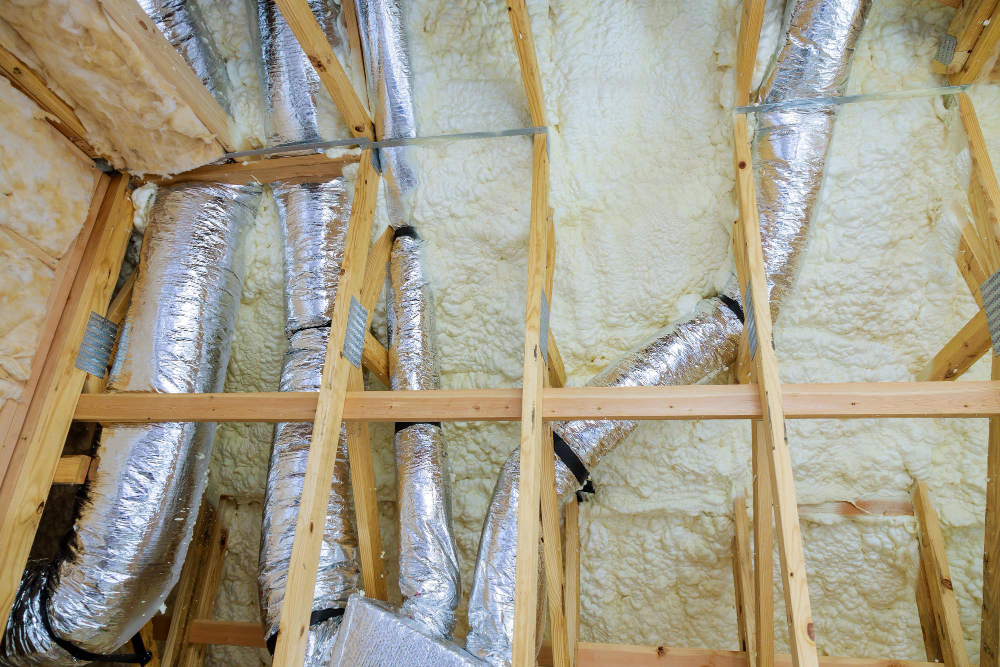
Closed-cell spray foam is the preferred material for rim joist work in Maryland because it solves the air leakage problem and the thermal bridging problem simultaneously. Applied directly to the interior face of the rim board, it expands to fill all gaps, penetrations, and irregular cavities around utility penetrations. The cured foam creates an air-impermeable layer that stops moisture-laden indoor air from reaching the cold wood surface.
The material properties that make it the right choice for this specific application are:
- High R-value per inch, typically around R-6 to R-7 per inch for closed-cell formulations, reaching the required performance target in 2 to 3 inches
- Air impermeability, which is the property fiberglass cannot provide and which is essential for preventing condensation
- Moisture resistance, protecting the structural framing from the humidity that Maryland's climate pushes into building assemblies year-round
- Adhesion to both wood and concrete, allowing it to bridge the sill plate-to-foundation joint where air infiltration is most concentrated
For homeowners comparing material options, spray foam insulation versus fiberglass shows a clear advantage for spray foam at the rim joist specifically, even when fiberglass is the better choice for other parts of the building envelope. The spray foam insulation for crawl spaces application uses the same closed-cell approach for the same reasons, and in homes where both the rim joist and crawl space are unaddressed, treating both in the same project is efficient and cost-effective.
Rigid foam as an alternative for accessible basements
In basements with good headroom and clean, flat rim joist bays, rigid foam cut to fit each bay and sealed at the perimeter with canned spray foam is an effective alternative. This cut-and-cobble approach uses extruded polystyrene or polyisocyanurate boards cut to fit snugly against the rim board in each joist bay, with the gaps around the edges of each piece sealed with spray foam or caulk to create a continuous air barrier.
The rigid foam approach requires careful installation to avoid leaving gaps at the corners of each bay and around utility penetrations. When done correctly, it achieves comparable thermal performance to spray foam at a lower material cost. When done with shortcuts, the unsealed perimeters of each cut piece leave enough air leakage to significantly reduce the upgrade's effectiveness. A professional installation eliminates this risk by ensuring consistent coverage and edge sealing around the full perimeter. Thermal insulation contractors in Maryland assess the specific conditions in each basement before recommending material, since access, ceiling height, existing utility penetrations, and moisture history all factor into which approach produces the best result.
How rim joist work fits into a broader home performance upgrade
Rim joist insulation delivers meaningful benefits on its own, but its impact is greatest when it is part of a whole-building approach that identifies and addresses every significant leakage and thermal bridging point in sequence. A professional home performance assessment is the right starting point for understanding where the rim joist sits in the priority order for your specific home.
Starting with an energy audit
A home energy audit establishes the baseline for every upgrade decision. The audit includes a blower door test that quantifies total building air leakage, a room-by-room inspection that identifies comfort problems and their likely sources, and an insulation assessment that covers the attic, walls, rim joist, and crawl space or basement.
In Maryland homes where the rim joist has never been addressed, it almost always appears in the audit report alongside the attic as a high-priority upgrade. Knowing the current condition before scheduling any work is how Maryland homeowners avoid investing in one zone while leaving an equally significant loss point unaddressed. The attic inspection services in Maryland that typically accompany a full energy audit give homeowners the complete picture in a single visit.
Combining rim joist and attic work for maximum impact
Completing the rim joist and attic in the same project phase is the most effective combination for Maryland homes. Together, these two upgrades close both ends of the stack-effect air exchange loop, address the two highest-leakage zones in the typical pre-2000 Maryland home, and produce energy bill reductions that are meaningfully larger than either upgrade delivers alone.
The cost-effective insulation approach for Maryland homeowners prioritizes these two zones before walls, because the attic and rim joist consistently deliver more energy savings per dollar invested than wall insulation work in this climate. Adding attic air sealing and rim joist insulation in the same scope also simplifies the rebate process, since both components are qualifying improvements under Maryland utility programs through BGE and Pepco Home Performance with ENERGY STAR.
Maryland utility rebates for rim joist work
Maryland homeowners can access rebates for qualifying insulation and air sealing improvements through BGE and Pepco's Home Performance with ENERGY STAR program. Rim joist air sealing and insulation qualifies as an envelope improvement, and projects that combine it with attic insulation typically qualify for higher rebate tiers because the modeled energy savings across the two upgrades are larger than either one alone.
The attic insulation tax rebate and envelope improvement incentives available to Maryland homeowners are best captured by starting with the energy audit, which establishes the documentation utilities and tax programs require. A residential insulation installation service that handles the full project from audit through installation and rebate application removes the administrative burden from the homeowner and ensures the scope of work is documented correctly for maximum incentive capture. The long-term economics through insulation energy bill savings consistently support the investment, and the rim joist is one of the faster-payback components in any whole-building upgrade scope.
Conclusion
Rim joist insulation in Maryland is one of the most direct and predictable improvements a homeowner can make to their building envelope. The benefits land immediately: warmer first-floor floors, reduced drafts along exterior walls, lower heating and cooling bills, and structural framing that is no longer accumulating moisture season after season. In a climate that pushes heat and humidity in from the outside for half the year and pulls heat out through the other half, closing this particular gap at the foundation perimeter pays for itself reliably and in both directions.
The upgrade is also straightforward to schedule, compact in scope, and frequently bundled with attic work for a combined project that produces results larger than either job alone. Starting with a professional assessment ensures the rim joist work is sequenced correctly within the full building envelope and positions the homeowner to capture available Maryland utility rebates that reduce the out-of-pocket cost of the improvement.
When you are ready to stop losing energy through the base of your Maryland home's framing, Terra Insulation is ready to help.